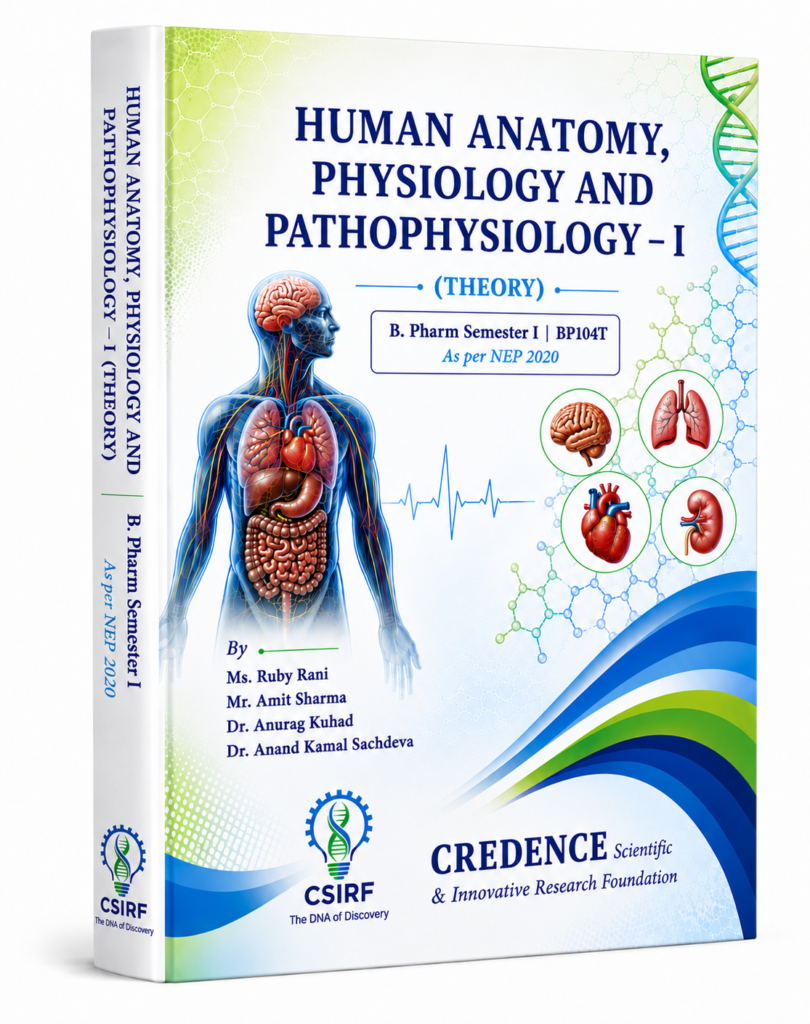
Ms. Ruby Rani, Mr. Amit Sharma, Dr. Anurag Kuhad & Dr. Anand Kamal Sachdeva
Information will be updated shortly
First Edition
English
Information will be updated shortly
CSIRF Publication (Imprint of Credence Scientific & Innovative Research)
As Per
NEP 2020
PCI Syllabus
Compliant
Student Friendly
Language
Examination
Focused
Well Structured
Content
Conceptual Clarity
with Diagram
Fill out the form below to request an examination copy or enquire about this book.
Human Anatomy, Physiology and Pathophysiology I (Theory) has been meticulously designed according to the latest Pharmacy Council of India (PCI) New Education Policy (NEP 2020) Syllabus 2026 for B.Pharm Semester-I (BP104T). This textbook provides a comprehensive foundation in the structure and functions of the human body while introducing the fundamental concepts of disease processes and pathological alterations.
The book systematically covers the organization of the human body from cellular and tissue levels to complex organ systems, enabling students to develop a strong understanding of anatomy, physiology, and pathophysiology. Special emphasis has been placed on correlating normal physiological functions with disease mechanisms, thereby helping learners bridge the gap between basic biological sciences and clinical pharmacy practice.
The content is organized into five comprehensive units covering cellular organization and tissue structure, integumentary and skeletal systems, blood and lymphatic systems, peripheral nervous system and special senses, and the cardiovascular system. Important pathological conditions such as psoriasis, dermatitis, leprosy, rheumatoid arthritis, osteoporosis, gout, anaemia, haemophilia, glaucoma, cataract, hypertension, cardiac arrhythmias, congestive heart failure, and ischemic heart diseases have been explained in a simple and student-friendly manner.
Written in accordance with the prescribed course outcomes, this book incorporates clear explanations, well-labelled diagrams, tables, flowcharts, and clinical correlations to facilitate effective learning and examination preparation. The presentation style has been carefully tailored to meet the needs of first-year pharmacy students, making complex concepts easy to understand and retain.
This textbook serves as an essential learning resource for students, teachers, and pharmacy professionals seeking a strong foundation in human anatomy, physiology, and pathophysiology. It aims not only to help students excel in university examinations but also to develop the scientific understanding necessary for future studies in pharmacology, therapeutics, clinical pharmacy, and healthcare practice.
This course aims to build a solid scientific foundation that enables pharmacy students to understand the relationship between normal body functions and disease conditions, thereby preparing them for advanced pharmaceutical and clinical studies.
Upon successful completion of the course Human Anatomy, Physiology and Pathophysiology I (Theory) (BP104T), students will be able to:
CO1: Explain the fundamental concepts of human anatomy, physiology, and pathophysiology, including the structural and functional organization of the human body.
CO2: Describe the gross morphology, microscopic structure, and physiological functions of various tissues, organs, and organ systems of the human body.
CO3: Understand the etiology, pathogenesis, clinical manifestations, and progression of diseases associated with the integumentary, skeletal, hematological, nervous, sensory, and cardiovascular systems.
CO4: Explain the mechanisms of cellular injury, adaptation, inflammation, wound healing, and repair, and correlate these processes with disease development.
CO5: Identify and differentiate various tissues, cells, organs, and body systems based on their anatomical features, physiological functions, and pathological alterations.
CO6: Interpret the relationship between normal physiological processes and pathological conditions to facilitate a better understanding of disease mechanisms.
CO7: Apply knowledge of anatomy, physiology, and pathophysiology to support the study of pharmacology, therapeutics, clinical pharmacy, and patient care.
CO8: Demonstrate the ability to correlate clinical signs and symptoms with underlying anatomical, physiological, and pathological changes relevant to healthcare and pharmacy practice.
The successful completion of this course equips students with a strong foundation in biomedical sciences and prepares them for advanced courses in Pharmacology, Pathophysiology, Therapeutics, Clinical Pharmacy, Pharmacotherapeutics, and Patient Care, thereby supporting their development as competent pharmacy professionals.

Pharmacology lecturer dedicated to simplifying biomedical concepts for students.

Experienced academician with expertise in pharmacology and research.

Renowned researcher specializing in pharmacology, neuroscience, and drug discovery.

Accomplished academician advancing pharmaceutical education, research, and publishing.